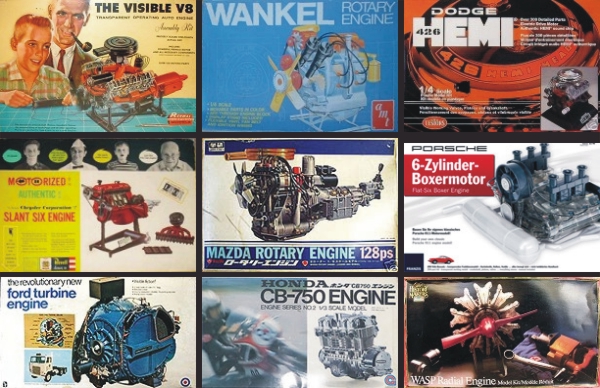
Car engines
|
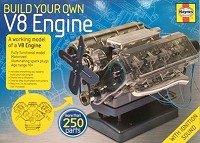
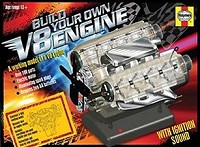
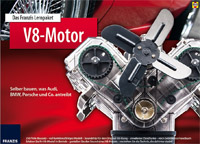
Appr. 1/2 scale generic OHC V-8
|
|
Functional and motorized model of a V-8 engine with overhead camshafts. More than 250 pieces. Illuminating spark plugs. Engine sound recording from a real V-8. The instructions are in Haynes 'Workshop manual' style. Model dimensions 420 x 300 x 110 mm. Requires three AA batteries
|
| Box art
| Manufacturer
| Cat #
| Year
| Comments
|
| Haynes
| HM10
| 2013
| European packaging
|
| Haynes
| HYE42839
| 2013
| US packaging
|
| Franzis
|
| 2016
| German boxing. Haynes logo in upper right corner
|
| MegaBleu
| HM10DE
| 2018
| Dutch-language version
|
| MegaBleu
|
| 2018
| French-language version
|
| Machine Works
| MWH10
| 2019
| Includes a Haynes-style manual
|
| Franzis
| 67114
| 2020
| German-English boxing
|
1/3 scale Wankel twin-rotor
|
|
The model depicts the NSU KKM 512, the engine of the NSU Ro-80. It is powered by an electric motor and tiny lightbulbs simulate the spark plugs. 125 parts.
|
| Box art
| Manufacturer
| Cat #
| Year
| Comments
|
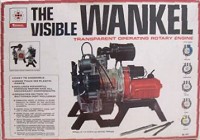
| Renwal
| 811
| ?
| Also issued as 811-1600 with small box differences
|
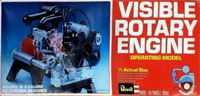
| Revell
| H913
| 1980
| molded in 4 colors, firing spark plugs. Renwal moulds were taken over by Revell in 1975
|
1/3 scale 2.3 liter four-cylinder turbo
|
Moving crankshaft, connecting rods, pistons, overhead cam valve train and timing belt. See-through turbo charger with manually moving impellers. Operating ignition system with firing spark plugs. Operating engine accessories including alternator, air pump and fan drive system.
Judging by the Ford logo on the box of the first issue, this model is probably inspired by the Ford 'Pinto' engine, a Ford Europe engine that was also produced by Ford USA. In 1979, a 2.3 liter turbocharged, non intercooled version was developed. It is also known as the Lima engine (it was built at the Lima (OH) engine plant, and as the 'LL23', LL short for 'Lima In-Line'.
|
| Box art
| Manufacturer
| Cat #
| Year
| Comments
|
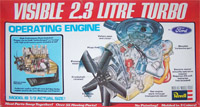
| Revell
| H906
| 1979
| The first issue of this model was motorized and flashing spark plugs. It could be built as a turbocharged (A) and a naturally aspired racing (B) version. The later has headers, velocity stacks and minimalistic carburetors.
|
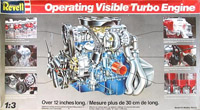
| Revell
| H8879
| 1985
|
|
| Revell
| HS879
| 1986
| Packaged in a plain cardboard box with some markings.
|
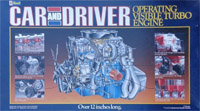
| Car&Driver
|
| 1985
| Small Revell-Ceji logo in top left corner. No Revell catalog number identified so far
|
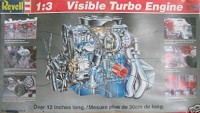
| Revell
| 8882
| 1993
| This issue has no electric motor, nor flashing spark plugs. A hand crank rotates the engine.
|
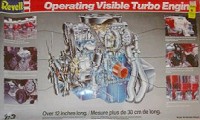
| Revell
|
| 1996
|
|
1/3 scale Ford 1965 Mustang 289 V-8
|
|
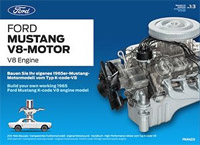
Functional and motorized model of a 1965 Ford Mustang 289 V-8 engine. Approximately 200 pieces. Requires three AA batteries for motorisation; motor is installed in the alternator. Illuminating spark plugs. Engine sound recording from a real V-8. Carburator representation very simple. |
| Box art
| Manufacturer
| Cat #
| Year
| Comments
|
| Franzis
|
| 2019
| German/English boxing. Youtube video Mustang Motor von Franzis - Bloch spielt #3 by 'Auto Motor und Sport'
|

| Franzis
| 67501
| 2023
| Updated version, but unclear what was updated.
|
1/3 scale Porsche four-cylinder boxer
|
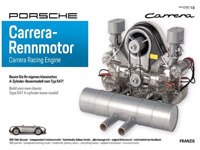
| Porsche Model 547 flat-4 boxer racing engine. 300 parts.
|
| Box art
| Manufacturer
| Cat #
| Year
| Comments
|
| Franzis
|
| 2018
| German boxing
|
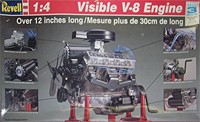
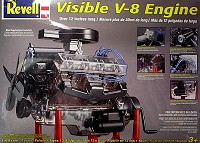
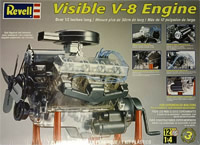
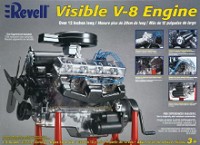
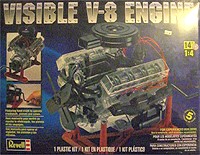
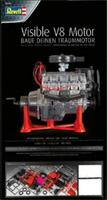
1/4 scale Studebaker 259/289 V-8 (previously listed as Pontiac 371/389)
|
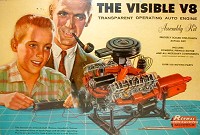
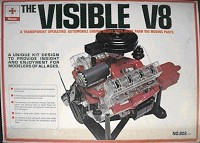
The model has moving pistons and connecting rods. The camshaft operates rocker arms and valves. Rubber fan-belt and vinyl ignition wires. Camshaft drives fuel pump. Includes display stand. Ton Hazelaar wrote a great construction article. Ebay seller Stunnuts sells a CD on how to build this model properly.
Often thought to be a Chevy block, it was previously reported that it mostly resembles a 1958 or 1959 Pontiac 371 or 389 engine (matching exhaust manifolds, alternator is on the left) or the Packard V-8 (matching valve covers, but the Packard alternator is on the right). Monty Montgomery made a very thorough analysis of this model's 1:1 scale inspiration:
The engine is a mashup of a couple different 1950s V-8 engines - they all looked kind of similar. There's one big difference with the real engines: the Visible V-8 has the right cylinders offset to the front of the left cylinders, which is the opposite of every American V-8 I know of. I'm currently building a 'dressed' version of the engine with a bit more attention to sorting out what parts came from where and decided it was mostly a Studebaker, so that's how I'm building it.
Going piece by piece, the engine is maybe 80% Studebaker 259/289. The unmistakable bits that had no real counterpart in another engine are the crank, geared cam, valve design/shape, and water pump. Several other bits match Studebaker, but also match a few other engines, like the straight/central oil filler, fuel pump on the left, balancer shape, plug placement, etc. The classic up-front Studebaker oil filter isn't there, but there was a dealer-installed full-flow option that did locate it on the right side where it is on the Visible V-8. If you move the generator to the right side of the engine and paint the red parts to a Studebaker engine color (they changed often, but were never red), you have to look close to see anything but a stock Studebaker.
That said... The fan detail closely matches a 1950s Chevy 389. This plus the engine originally being red is probably the only thing that's 'Chevy-ish', but I'm sure anyone who owns a Chevy notices that first :-) The transmission is a first version GM Hydramatic (I think at the time that would have been primarily on Cadillac). The carburetor is a Rochester 2GC, that also would have been from a GM engine. The starter motor shape and starter/generator position are classic Oldsmobile Rocket 303. The generator itself is just a generic Delco. Many parts don't really match anything. The intake manifold and headers are just sort of a blocky generic design.
I don't see any resemblance anywhere in the engine to a Pontiac. The Pontiac engine designs of the time were kind of unusual in several ways, and all the signature things that made a Pontiac V-8 a Pontiac aren't there. I also don't see any resemblance to a Packard engine except in a generic sort of way. Packard and Studebaker merged in the 1950s, but the engine lines were kept separate.
Revell also made a working store display of the Visible V-8 engine. It was a flat box showing a cross section of the engine, with lighting to show the spark plugs operating. Catalog number is B-905, and it was issued in 1979.
|
| Box art
| Manufacturer
| Cat #
| Year
| Comments
|
| Renwal
| 802
| < 1962
| Motorized
|
| Renwal
| 802
| ?
| Motorized
|
| Renwal
| 802
| ?
| Motorized. Simple cardboard box with printing. Instructions show the box-art drawing of the box shown above, therefore this appears to be a later issue.
|
| Revell
| HS902
| 1977
| Packaged in a plain cardboard box with some markings. Motorized. Renwal moulds were taken over by Revell in 1975. Revell made small modifications. The spark plugs were raised, by cilindrical extensions of the mounting holes. This was probably done to make the lights better visible. The pushrods got rounded ends and are slightly longer.
|

| Revell/J.C Penney
|
| 197.
| no information so far. Could well be the model shown above.
|
| Revell
| 0902
| 1977
| Motorized.
|
| Revell
| 8883
| 1996
| The design was changed with a hand-operated crank instead of an electric motor. The working distributor with little lights in each spark plug was also deleted; the distributor is no longer driven from the camshaft either. It appears that the transmission case was deleted too. The starter motor parts were changed, deleting the bulky gear reduction; the starter motor now looks more like the real thing.
|
| Revell
| 8883
| ?
| Almost similar box art but with a red band
|
| Revell
| 85-8883
| 2005
| Hand crank
|
| Revell
| 85-8883
|
| Slightly different box art
|
| Revell
| 85-8883
| ?
| Almost similar box art but with a different Revell logo
|
| Revell
| 85-8883
| 2013
|
|
| Revell Germany
| 00460
| 2022
| announced for June 2022
|
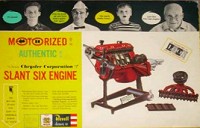
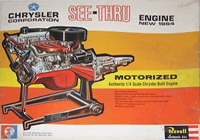
1/4 scale Chrysler 1960 170 cubic inch 'Slant Six' six-cylinder in-line
|
|
Issued late 1961 together with six Chrysler car models representing the whole 1962 line-up. Tooled from Chrysler blueprints, it had very realistic engraving and details, much better than the generic Visible V-8. Approximately 300 parts molded in four colors: black, red, silver and gray. Several parts can be removed to show the functions: the valve cover, the oil pan, the intake and exhaust manifolds, the left side of the cylinder head, and the left side of the cylinder block. The A903 three-speed manual transmission houses the electric motor that drives the crankshaft, pistons and valves. Light-up spark plugs timed through the distributor. The MoparMax site has an excellent article on this model's history, as does Steve Magnante's 'A Few of My Favorite Things' article.
|
| Box art
| Manufacturer
| Cat #
| Year
| Comments
|
| Revell
| H1553
| 1961-62
| Opaque parts
|
| Revell
| H1555
| 1963
| 'See Thru' version with some clear parts. The engine was updated with optional California 'anti-smog' crankcase ventilation parts.
*Note: for years the wrong box art was shown here*
|
1/4 scale Wankel twin-rotor
|
| Reportedly a realistic model of a real rotary engine. It has planetary gears in the rotors, and it can be manually operated by rotating the flywheel. No electronics.
|
| Box art
| Manufacturer
| Cat #
| Year
| Comments
|
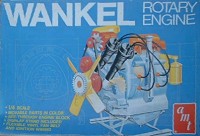
| AMT
| T575
| 1974
| Two clear sprues, one blue and one yellow sprue
|
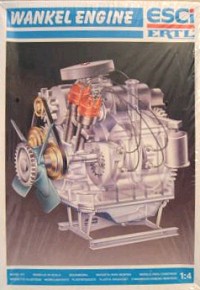
| Esci-Ertl
| 3400
| 1992
| Two clear sprues, two blue sprues. Build report by Attila Vígh in Hungarian
|
1/4 scale Dodge 426 V-8 Hemi
|
|
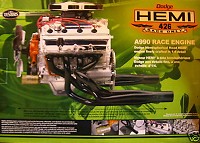
A replica of the 426 Hemi Sports from 1964-1965. More than 300 clear, silver and chrome plated parts. Working crankshaft, pistons, cam and valves, powered by an electric motor. 9 inches long.
|
| Box art
| Manufacturer
| Cat #
| Year
| Comments
|
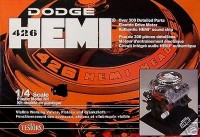
| Testors
| 452
| ?
|
|
1/4 scale Dodge 426 V-8 Racing Hemi
|
|
Visible working engine with sound chip and action. Over 300 parts, working valves, pistons and crankshaft. Powered by an electric motor.
|
| Box art
| Manufacturer
| Cat #
| Year
| Comments
|
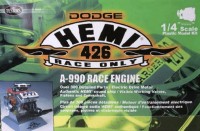
| Testors
| 453
| ?
|
|
| Testors
| ?
| ?
|
|
1/4 scale Ford 1948 Flathead V-8
|
|
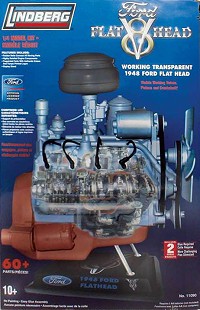
60+ parts, working pistons and valves.
|
| Box art
| Manufacturer
| Cat #
| Year
| Comments
|
| Lindberg
| 11090
| ?
| Announced in 2009 Lindberg/Hawk catalog, but it now seems to have been canceled. Lindberg did issue two versions of a 1/6 scale, non-visible engine model. They both have a die-cast crankcase. Catalog number 11081 (2008) represent a 1949 version and is a kit to be assembled; catalog number 11082 represent a 1948 version that is ready-made.
|
1/4 scale Porsche six-cylinder boxer
|
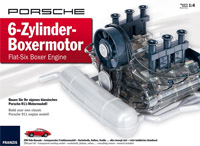
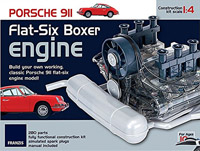
| Functional and motorized model of the 1966 two-liter Porsche 6-cylinder boxer engine. 290 parts, snap fit or with small screws. Requires three AA batteries. Engine sound recording. Model dimensions 320 x 280 x 250 mm.
|
| Box art
| Manufacturer
| Cat #
| Year
| Comments
|
| Franzis
|
| 2016
| German/English boxing
|
| Franzis
|
| 2016
| English-only packaging. Often advertised as a Haynes model, but the Haynes logo is not visible
|
| Machine Works
| MWHPE1
| 2021 ?
| English-only packaging. Simplified manual
|
1/4 scale Volkswagen four-cylinder boxer
|
| Functional and motorized model of the 1946-1953 1131 cc Volkswagen four-cylinder boxer engine of 25 horsepower. 200 parts, snap fit or with small screws. Requires three AA batteries. Engine sound recording. Model dimensions 200 x 220 x 170 mm (W x H x D).
|
| Box art
| Manufacturer
| Cat #
| Year
| Comments
|
| Franzis
|
| 2020
| German/English boxing
|
1/4 scale Volkswagen Transporter 'T1 Bulli' four-cylinder boxer
|
| Functional and motorized model of the 1950-1953 1131 cc Volkswagen four-cylinder boxer engine of 25 horsepower, as used in the first version of the Transporter, aka VW-bus, aka Bulli. 200 parts, snap fit or with small screws. Requires three AA batteries. Engine sound recording. Model dimensions 200 x 220 x 180 mm (W x H x D).
|
| Box art
| Manufacturer
| Cat #
| Year
| Comments
|
| Franzis
| 67152
| 2021
| German/English boxing
|
1/5 scale Mazda 10A Wankel
|
|
Judging by the look and colors, this appears to be a 10A model as fitted in the Cosmo 110. The same engine was also fitted in the R100 and early RX-3 but with a blue air cleaner. Parts to engine include an air cleaner, fan, fan belt, generator, starter, stick shift, and transmission housing. Runs on two batteries. Includes wiring and vinyl tubing. Reported inaccuracies: "the rotors are wrong dimensions, the internal gears are fake, eccentric shaft is all wrong, all of which has to do with making it turn over via the electric motor. Not a bad kit and at least they got all the external stuff close to the 1:1 prototype."
|
| Box art
| Manufacturer
| Cat #
| Year
| Comments
|
|
| Bandai
| ?
| ?
| The first issue, whether Bandai or Gakken, was in 1969, and imported in the UK in that year by RiKo
|
| Gakken
| 81588
| ?
| The first issue, whether Bandai or Gakken, was in 1969, and imported in the UK in that year by RiKo
|
| Entex
| 8201
| ~1973
| Made by Gakken for Entex.
|
| Minicraft
| 11201
| 1996
|
|
| Minicraft
| 11201
| 2001
|
|
1/6 scale Chevrolet 283 ci V-8
|
|
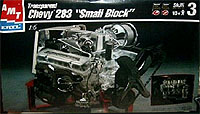
300 parts including engine stand, vinyl belts and ignition wiring. Photo-etched data plaques in (at least) the #8337 issue. Flywheel turns crankshaft and pistons, parts can be removed to show interior detail and functional parts. Comments: 'very realistic' and 'AMT gives you a rubber timing chain that just will not stay in place on the cam gear so the crank won't drive the cam shaft & rockers/valves'.
|
| Box art
| Manufacturer
| Cat #
| Year
| Comments
|
| AMT/Ertl
| 8337
| 1998
|
|
| AMT
| 8340
| 1999
|
|
1/6 scale Ford or Opel four-cylinder side-valve engine
|
|
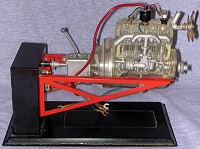
This is a German model from the fifties, that was to be assembled with the supplied screwdriver and wrench.
The see-through engine block, sump, and head are made of plastic, all other parts are metal. By turning the handcrank the pistons, camshaft and valves are operated. The 3-volt battery powered spark plugs fire in sequence. The engine is fitted with a working three-speed gearbox with reverse, and even a clutch that is functional. Combined length is around 15 centimers / 6 inches. The engine is mounted on a steel base. There are two accounts of the inspiration of this model. The first one is that it is a Ford Model T engine, the second that it was patterned after a pre-war Opel engine. Philippe de Lespinay has a great webpage on this engine.
|
| Box art
| Manufacturer
| Cat #
| Year
| Comments
|
| Gescha
| ?
| 'fifties
| Available with German and English language instructions
|
1/8 scale Chevrolet 283 cubic inch V-8
|
|
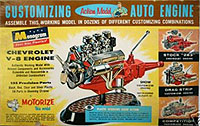
Can be built as a stock Chevrolet 283, a show customized engine, a drag strip engine, a competition customized engine, and dozens of variations. Contains a supercharger, tuned exhausts, seven carburetors, six intake manifolds, and a display stand. 135 parts in black, red, clear and silver plastic. Contains clear plastic windows and inspection appartures to watch the internal action. The model could be motorized with the 'Motor Power Kit', catalog number AK100. It's reported that Monogram used a simplified version (without the 'visible' features) in the large-scale Big T, Big Tub, Big Drag and Big Rod kits.
|
| Box art
| Manufacturer
| Cat #
| Year
| Comments
|
| Monogram
| PE62
| 1960
| 'Plastikit Action Model'
|
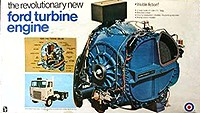
1/8 scale Ford 707 gas turbine
|
|
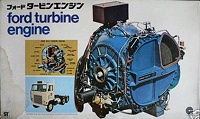
Single-stage gas turbine for truck use, 375 horsepower. Fitted in a production Ford W-1000 for demonstration purposes in 1966. Various parts of the model can be taken off to get a view of the internals. Has some transparent parts internally. Motorized. Includes radiator with fan.
|
| Box art
| Manufacturer
| Cat #
| Year
| Comments
|
| Gakken
| Engine series No. 3
| ?
|
|
| Entex
| 8480
| 1973
| Two builds are shown here: Entex 1/8 Ford Turbine Truck Engine on the MCM forum
|
1/12 scale Ferrari V12 engine
|
|
The 12 cylinder engine of the Ferrari 250 GTO. Resin and white metal parts, plus turned metal parts and photo-etched sheet. The crankcase is transparent, and pistons, rods and crankshaft appear to be 'working'
|
| Box art
| Manufacturer
| Cat #
| Year
| Comments
|
| Model Factory Hiro
| KE004
| 2016
|
|
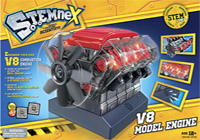
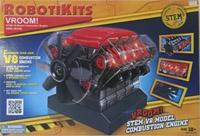
1/x scale generic V-8
|
|
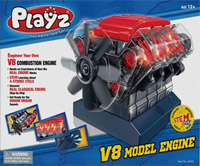
270 parts in various colors. Sound.
|
| Box art
| Manufacturer
| Cat #
| Year
| Comments
|
| Stemnex / Amazing Toys
| 39102
| 2019
|
|
| Owikit Robotikits / OWI Robotics
| OWI-39102 / 89460
|
|
|
| Playz
|
|
| US distribution
|
1/x scale generic four-cylinder
|
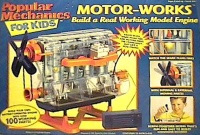
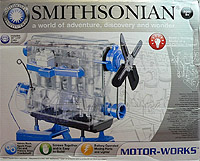
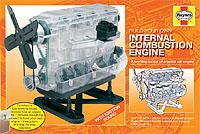
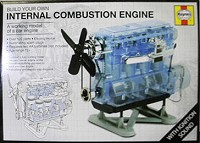
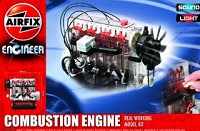
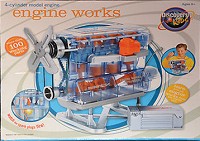
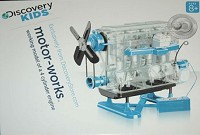
| Generic four cylinder engine, it doesn't represent any particular original. Moving pistons, valvegear and fan belt, electric motor, illuminating spark plugs, ignition sound. Over 100 parts. Finished model size 180 x 270 x 140 mm (H x W x D). Reportedly it was designed by Heller, but could not market the kit as they had run into difficulties.
|
| Box art
| Manufacturer
| Cat #
| Year
| Comments
|
| Popular Mechanics
|
|
|
|

| Smithsonian
|
|
|
|
| Smithsonian
|
|
|
|
| Haynes
| TY4132
|
|
|
| Haynes
| 81413
|
|
|
| Airfix
| A42509
| 2010
|
|

| Humbrol / Young Scientist
|
|
|
|
| Discovery Kids
|
|
|
|
| Discovery Kids
|
|
|
|
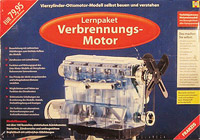
| Franzis
|
| 2001+
| German boxing. Small Haynes logo in upper right corner
|
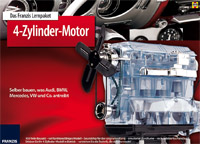
| Franzis
|
| 2016
| probably the second boxing by Franzis. Small Haynes logo in upper right corner
|
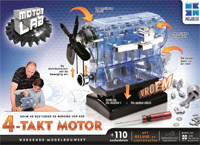
| MegaBleu
|
| 2018
| Dutch-language version. Foot has been changed, and separate battery box has been deleted.
|
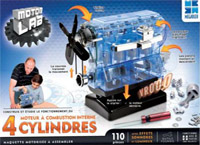
| MegaBleu
|
| 2018
| French-language version
|
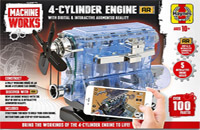
| Machine Works
| MWH04
| 2019
| Includes a Haynes-style manual
|
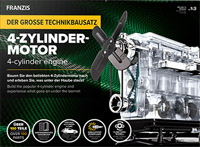
| Franzis
| 671752
| 2021
| German-English version
|
1/x scale generic four-cylinder
|
| Generic four cylinder engine, possibly an update of the above model? Moving pistons, valvegear and fan belt, electric motor and LED spark plugs. 104 parts. Finished model size 248 x 249 x 146 mm (H x W x D).
|
| Box art
| Manufacturer
| Cat #
| Year
| Comments
|
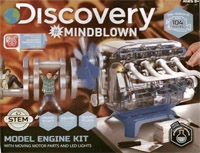
| Discovery Mindblown
|
| 2019
| US version probably
|
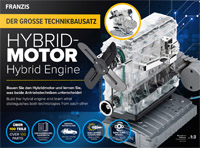
1/x scale generic hybrid engine
|
| Generic four cylinder hybrid engine, looks an update of the generic four-cylinder model shown above (the one issued by at least ten manufacturers). Additional alternator and a simulated battery pack. Over 100 parts.
|
| Box art
| Manufacturer
| Cat #
| Year
| Comments
|
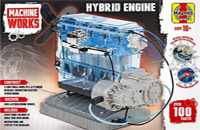
| Machine Works
| MWHY14
| 2021
| Includes a Haynes-style manual
|
| Franzis
| 67157
|
| German-English version
|
Motorcycle engines
|
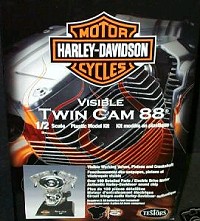
1/2 scale Harley-Davidson Twin Cam 88
|
|
Working valves, pistons and crankshaft, driven by electric motor. Over 150 parts, over 13" tall. Clear external parts that allow a clear view of internals. Includes a sound card recording of the real engine.
|
| Box art
| Manufacturer
| Cat #
| Year
| Comments
|
| Testors
| 460
| 2006
| See Visible Harley Twin Cam 88 Engine 1/2 Scale by Doug Sampson on the MCM forum
|
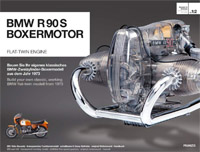
1/2 scale BMW R90S twin boxer
|
| BMW type 247 engine, 898 cc and 67 hp as installed in BMW's top of the line R90S motorcycle of 1973 vintage. Engine with moving pistons and camshaft plus working gearbox, driven by electric motor. 200 parts in clear, gray, yellow and chromed plastic. Sound module. No sparkplug light. Model dimensions 160 x 355 x 465 mm (W x H x D)
|
| Box art
| Manufacturer
| Cat #
| Year
| Comments
|
| Franzis
|
| 2019
| German and English text
|
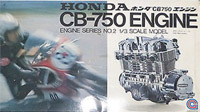
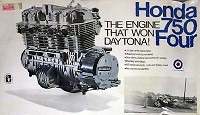
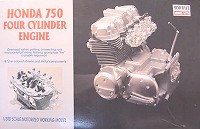
1/3 scale Honda 750 four-cylinder
|
|
187 pre-colored styrene and metal components. Moving overhead valves, pistons, connecting rods and crankshaft. Flashing spark plugs fire in proper sequence. Runs on batteries. Kit also includes the gear box, battery box, crank case, oil pan, and the carburetor. Includes wiring and vinyl tubing. Display stand and nameplate included. Very detailed instructions, with several major trouble-shooting tips in back.
|
| Box art
| Manufacturer
| Cat #
| Year
| Comments
|
| Gakken
| ?
| 1972
|
|
| Entex
| 8221
| ?
|
|
| Minicraft
| 11202
| ?
|
|
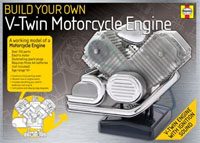
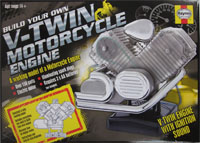
1/x scale generic V-twin
|
|
Simplified and generically looking V-twin. 150+ plastic parts. Runs on an electric motor. Flashing spark plugs. Sound chip generates starting and running sounds.
|
| Box art
| Manufacturer
| Cat #
| Year
| Comments
|
| Haynes
| HMV2
| 2014
| UK boxing
|
| Haynes
| HMV21
| 2014
| US boxing
|
| Franzis
|
| 2016
| German boxing, small Haynes logo in upper right corner
|
| Machine Works
| MWHV2
| 2020
| Includes a Haynes-style manual
|
Aircraft engines
|
1/4 scale Pratt & Whitney Wasp 9-cylinder radial
|
|
Cylinders and crankcase molded clear, while the valves, connecting rods, push rods, rocker arms, gears, etc. are molded in opaque plastic. The prop is a replica of a constant speed (variable pitch) propeller, so each of the two blades can be moved at right angles to the center hub of the propeller shaft.
|
| Box art
| Manufacturer
| Cat #
| Year
| Comments
|
| Renwal
| 809
| 1960 ?
| Motorized, with lights hooked into the distributor to light in sync with the firing sequence.
|
| Revell
| 8614
| 1981
| 'History makers' reissue. Has no motor or operating lights. Renwal moulds were taken over by Revell in 1975
|
1/6 scale Le Rhone 80 hp 9-cylinder rotary
|
|
Not a visible model.
|
| Box art
| Manufacturer
| Cat #
| Year
| Comments
|
|
| Williams Brothers
| 302
| ?
| -
|
|
| Williams Brothers
| 30200
| ?
| Box has a blue dot (1/8 scale model boxing has a yellow dot). Two zeros added to the original catalog number at the introduction of bar codes.
|
| Williams Brothers
| 30260
| ?
| Rereleased with new box art in January 2009
|
1/8 scale Le Rhone 80 hp 9-cylinder rotary
|
|
Not a visible model.
|
| Box art
| Manufacturer
| Cat #
| Year
| Comments
|
|
| Williams Brothers
| 301
| ?
| -
|
| Williams Brothers
| 30100
| ?
| Yellow dot indicates 1/8 scale (1/6 scale model boxing has a blue dot). Two zeros added to the original catalog number at the introduction of bar codes.
|
1/8 scale Pratt & Whitney Wasp 9-cylinder radial
|
|
Not related to the Renwal/Revell model, and not a visible model. Note that William Brothers also produces 1/4, 1/5, 1/6, 1/8, 1/12 and 1/32 Wasp engines, but these are simple 'dummy' models for RC models, and not detailed like the #307 / #30700.
|
| Box art
| Manufacturer
| Cat #
| Year
| Comments
|
|
| Williams Brothers
| 307
| ?
|
|
| Williams Brothers
| 30700
| ?
| molded in two colors: black cylinders, gray nine-cylinder crankcase. Two zeros added to the original catalog number at the introduction of bar codes.
|
1/8 scale Wright J-5 Whirlwind 9-cylinder radial
|
|
The engine that powered Lindbergh's Ryan 'Spirit of St Louis'. Not a visible model.
|
| Box art
| Manufacturer
| Cat #
| Year
| Comments
|
|
| Williams Brothers
| 304
| ?
| -
|
| Williams Brothers
| 30400
| ?
| Two zeros added to the original catalog number at the introduction of bar codes.
|
1/11 scale Allison T56 (501-D13) turboprop
|
|
Cutaway model of the engine used in the Lockheed L188 Electra and the Lockheed P-3 Orion. The version for the Lockheed C-130 had the gearbox rotated 180 degrees, among others (see this conversion). It is most likely based on a full-scale T-56 instruction engine. The model is missing a couple of pipes compared to the real engine. The scale rather unclear, 1/10 is printed on the 1991 box, 1/12 is also mentioned.
|
| Box art
| Manufacturer
| Cat #
| Year
| Comments
|
| Revell
| H1151
| 1960
|
|
| Revell
| H1152
| 1960
|
|
|
| Revell
| 8606
| ?
| Possibly a plain cardboard box version issued in the sixties, like Revell's V-8 H902. It had a smaller box and looked like a mail order version
|
| Revell
| ?
| 1982
| 'History Makers' reissue. Molded in two instead of four colors.
|
| Revell
| 8880
| 1991
|
|
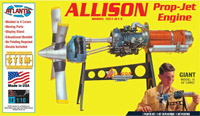
| Atlantis
| H1551
| 2019
| Build review on IPMS-USA website
|
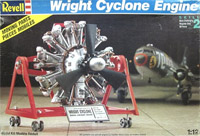
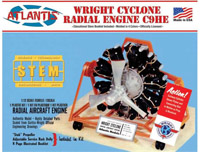
1/12 scale Wright Cyclone 9-cylinder radial
|
|
The only 'visible' feature was one cylinder that showed a piston going up and down.
|
| Box art
| Manufacturer
| Cat #
| Year
| Comments
|
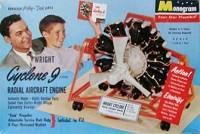
| Monogram
| PE52
| 1959
|
|
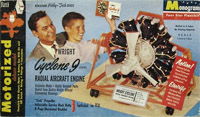
| Monogram
| PE252M
| 1959
| motorized version of the above
|
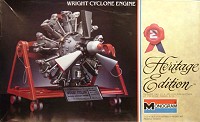
| Monogram
| 6052
| 1983
| 'Heritage Edition' reissue
|
| Revell
| 8881
| 1991
|
|
| Atlantis
| M6052
| 2021
|
|
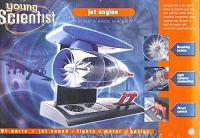
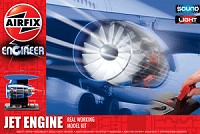
1/x scale generic turbofan
|
|
Turbofan engine mounted on wing pylon with throttle control.
|
| Box art
| Manufacturer
| Cat #
| Year
| Comments
|
| Hornby Young Scientist
| af20005
| 2009
|
|
| Airfix
| A20005
| 2010
|
|
Generic engines
|
1/x scale four-stroke
|
| This kit depicts a single cylinder stationary engine. Bore 1 inch, stroke 1 1/4 inch. Crankcase, timing case and cylinder head are sectioned to allow viewing.
|
| Box art
| Manufacturer
| Cat #
| Year
| Comments
|
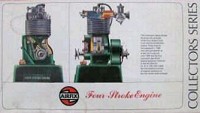
| Airfix
| C701S or 07551 and 07870
| 1972
| Can be fitted with an electric motor. Part of the 'collector series', that appears to have consisted of four engines of various sorts, including a steam powered beam engine. All the kits were motorised when first released.
|
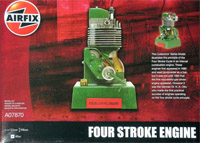
| Airfix
| A07870
| 2012
| Reissue without the option of motorisation.
|
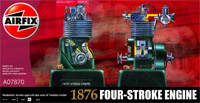
| Airfix
| A07870
| 2016 ?
| Box title is now '1876 Four-Stroke Engine'
|
Other engines
|